Promising developments in speaking are starting in schools

There are some exciting advances right now, promoting learning though the use of speech and discussion in some forward-thinking schools in the UK. At the forefront, not only in emphasising speaking skills, but in developing a whole philosophy of learning through talk and discussion, is School 21 in East London.

School 21 describes itself as “a state-funded, non-selective 4-18 school in Stratford, East London. It is an innovative school, committed to doing things differently for the twenty-first century. The school supports its students to become articulate children who can take on the world, through dedicated oracy lessons and a culture of productive talking throughout the school.”

So what is Oracy? School 21 has teamed up with Cambridge University’s Education department for the further development of Oracy. They divide Oracy skills into 4 categories:-

Cognitive – the deliberate application of thought to what you are saying

Linguistic – knowing which words and phrases to use, and using them

Physical – making yourself heard, using your voice and body as an instrument

Social – engaging with the people around you; knowing you have the right to speak


“Oracy” really represents the set of talk skills that children, that people, should develop, in the same way that we would expect people to develop reading and writing skills. [It] sums up that teachable set of competencies to do with spoken language” Professor Neil Mercer Cambridge University Department of Education


The School is supported by the 21 Trust and Voice21.

“The 21 Trust creates education institutions and programmes designed to help children succeed in the 21st century.” Voice 21 is a campaign to raise the status of oracy in schools across the UK and get more talking into class. Voice 21 is working with schools across the UK to help develop the tools and resources to ensure every student is taught to communicate effectively. It believes that oracy, the ability to communicate effectively using spoken language, should have the same status as numeracy and literacy. Voice 21 is launching an inquiry, led by an independent Commission, to consider and make recommendations on the future of speaking within our education system.

Next time I’ll describe the inspiring day that my colleague Lisa Field and I spent at School 21.
Learning to speak with confidence is at the heart of effective communication

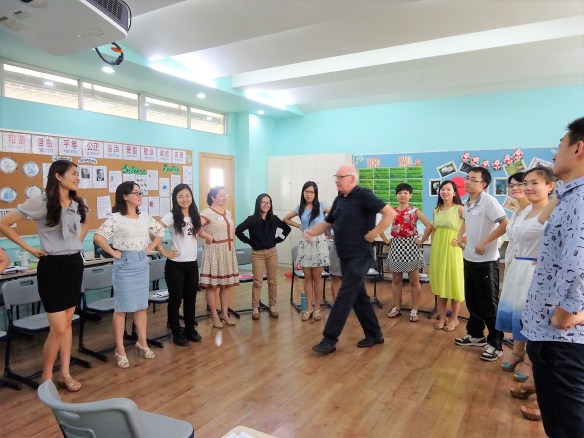
I was asked recently – whilst teaching interpersonal skills during a visit to China – where did my interest in promoting speaking skills start? I had to think for a moment, as this has been a passion for many years now and I had almost forgotten how it all began.

In 2004, after around 12 years teaching Speech and Drama at Benenden, one of England’s top girls’ boarding schools, I decided it was time to expand my activities and I started to also teach speaking skills to the wider business community, under the name Speak Up.

I was having lunch with Benenden’s director of studies when he made a connection between the two sides of my business. “Graham, with you and your Speak Up programme, do you think you can get the Chinese girls to speak up. They are so quiet in class and we want them speak up and join in more!”

Here’s a challenge, I thought. I didn’t want the girls to think they were being singled out for a lack of skills, so I described the classes as fun sessions designed to increase confidence in Spoken English and I booked a comedian actor friend. We did lots of drama games and role play, and showed the girls how they could join in conversations between loud and talkative English girls and how they could use body language to gain more confidence. The girls described our lessons as ‘confidence fun time’ and they all made great progress as well as enjoying themselves. This was when I first realised that with a carefully selected combination of lively and fun drama exercises, all students, (not just those who already like drama) could benefit greatly. A very successful recipe for boosting confidence and encouraging more fluent English.

Following the success of these sessions I was asked to take the programme to Hong Kong.

Benenden school’s much loved benefactor, Hong Kong businessman Mr Michael Leung, is governor of a number of schools there and he promoted our summer holiday course in HK under the name ‘Speaking with Confidence’. I ran these courses for four years and for the last two I was assisted by whole of the Lee family!

This was the beginning of my fasciation in and love for Hong Kong and mainland China. We took advantage of those four years to travel widely in China and since then we have kept up contacts and interests there. Recently we have visited Guangzhou, Shanghai and Hong Kong to run courses, as well as collaborating on a book for the Chinese market about applying to English Boarding schools.

I still firmly believe that a key to success in life is learning how to develop personal confidence, so that you can speak confidently. Look at the successful people around you or in the media. Those who have made it to the top in business, politics and the media show this personal confidence and an ability to use their communication skills to connect with everyone they meet.

I have been disappointed with the recent lack of emphasis on speaking skills in many schools in the UK state sector. This is typified by the down-grading of the speaking and listening section of the English Language GCSE.

In my next piece I shall write about an innovative initiative to develop speaking skills in schools. An initiative that absolutely aligns with my many years of working in this area in the UK and China.

Teaching English teachers in Guangzhou some confidence building tips